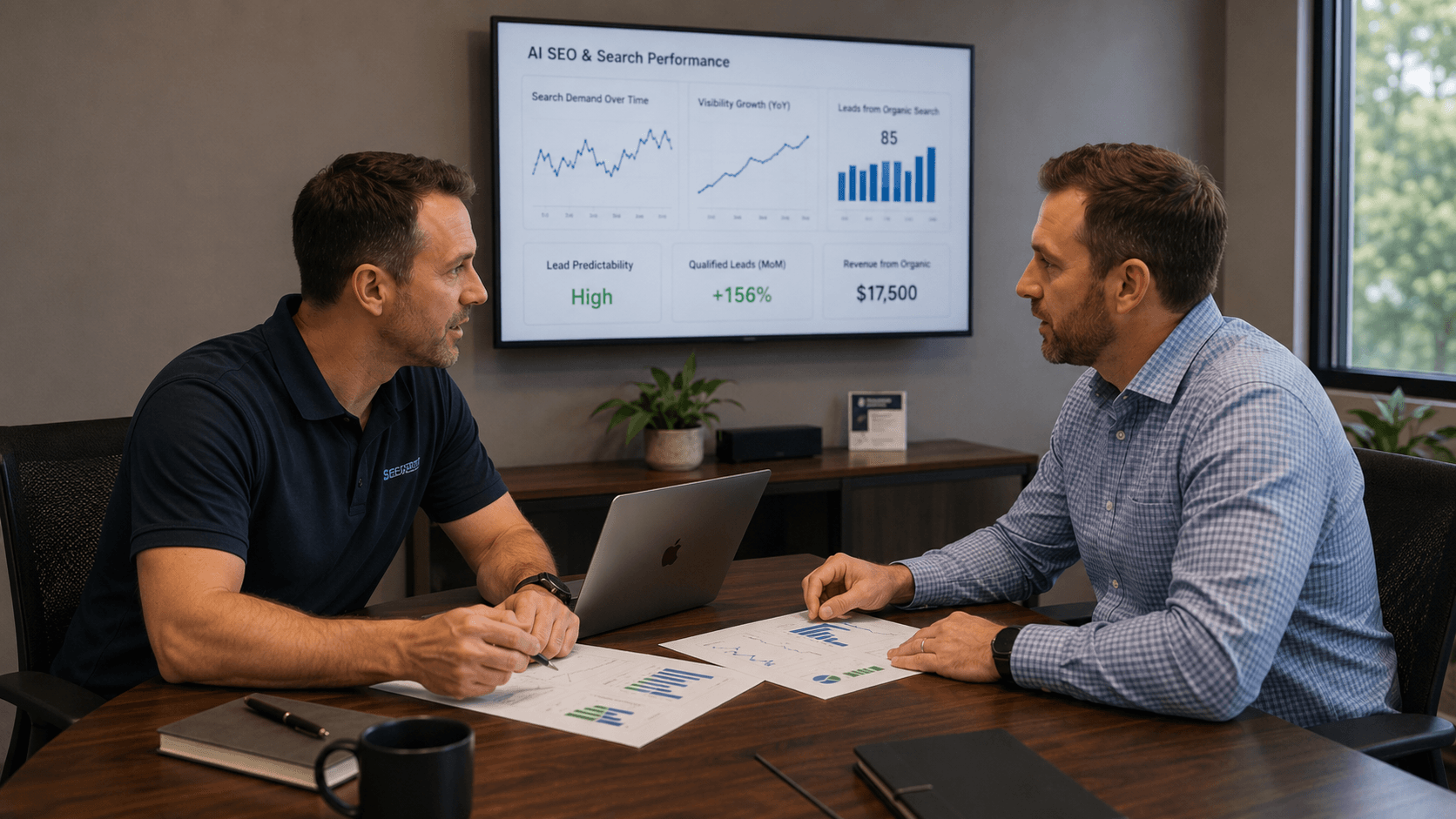
Lead predictability is the ability to forecast consistent inbound leads using AI SEO models, keyword intent data, and historical conversion patterns. Buyers evaluate it by examining search demand stability, conversion signals, and attribution accuracy across organic and paid channels to confirm future revenue reliability.
Key Takeaways
- Lead predictability is driven by AI SEO insights combined with real search demand and conversion data
- Buyers expect transparent forecasting backed by keyword trends and measurable performance signals
- AI models improve accuracy by mapping intent-based search behavior to conversion outcomes
- Geographic segmentation strengthens forecasting reliability across markets like Greeley, Fort Collins, and Windsor
We see a major shift in how buyers evaluate marketing performance in 2026. Instead of relying on traffic reports or vague projections, they want verified systems that explain exactly how leads will behave over time. This is why frameworks like How to Prove Lead Predictability to Buyers Using AI SEO and Search Data are becoming central to modern growth conversations.
Companies like Dynamic Homes Colorado, which provides residential solar solutions, are increasingly evaluated on their ability to demonstrate consistent inbound demand rather than one-off campaign spikes. Similarly, agencies such as Digital HVAC Marketing, founded in February 2017, have built their approach around predictable SEO-driven pipeline generation across competitive local markets.
What does lead predictability mean in AI-driven SEO environments?
Lead predictability refers to the ability to consistently forecast inbound leads using structured SEO data, AI modeling, and conversion analytics. It replaces guesswork with measurable demand signals that can be tracked, tested, and projected over time.
In modern SEO systems, predictability is built on intent mapping rather than simple keyword rankings. We analyze how users search, what they expect, and how likely they are to convert based on query structure and engagement behavior.
This becomes especially important in regional markets like West Greeley and Downtown Greeley, where demand fluctuates based on seasonality, housing growth, and service availability.
Why buyers prioritize predictability over volume
Buyers today are more focused on consistency than raw lead volume. A stable pipeline is far more valuable than unpredictable spikes that cannot be forecasted or scaled.
AI SEO helps normalize volatility by identifying patterns across keyword clusters, conversion rates, and SERP behavior.
- Transactional search intent stability
- Seasonal demand shifts across service categories
- Click-through rate variations by keyword type
For example, search behavior in Fort Collins often reflects research-driven intent, while Windsor shows more immediate service-based conversion intent.
How do we use AI SEO and search data to forecast leads accurately?
We forecast leads by combining AI-driven SEO insights with real-time search behavior, historical performance data, and conversion tracking systems. This allows us to build predictive models that estimate future lead flow with increasing accuracy.
To explain How to Prove Lead Predictability to Buyers Using AI SEO and Search Data effectively, we rely on three core data layers that work together to create forecasting clarity.
Search demand intelligence
We evaluate what users are searching for, how often they search, and what their intent signals reveal about readiness to convert.
This includes high-intent service queries, comparison searches, and location-based searches tied to urgent needs.
Behavioral engagement signals
Once users land on a site, we track engagement patterns that indicate lead quality.
- Time on page and scroll depth
- CTA interactions and form submissions
- Navigation behavior across service pages
A field-level insight we often hear from technicians is simple: leads generated from high-intent search terms tend to convert faster and require fewer touchpoints before closing.
Conversion mapping and attribution
We connect search activity directly to revenue outcomes by mapping keyword clusters to closed deals. This allows us to identify which queries consistently produce high-value customers and long-term revenue.
What metrics actually prove lead predictability to buyers?
Buyers require measurable proof that forecasting systems are reliable. That means focusing on KPIs that directly connect search activity to revenue outcomes rather than vanity metrics.
When evaluating How to Prove Lead Predictability to Buyers Using AI SEO and Search Data, we prioritize performance indicators that reflect real-world conversion behavior.
Keyword stability index
This metric measures how consistently keywords maintain rankings and impressions over time, indicating long-term demand stability.
Conversion rate by intent cluster
We group keywords into intent categories such as emergency, pricing, and comparison searches to evaluate conversion performance more accurately.
Lead velocity rate
This measures how quickly leads grow month over month, helping buyers understand momentum and scalability.
How does geography influence lead predictability models?
Geographic segmentation is a critical component of accurate forecasting. Search behavior varies significantly across nearby cities and neighborhoods, which directly impacts lead flow.
In Northern Colorado, we see distinct demand patterns across West Greeley, Downtown Greeley, Fort Collins, Evans, and Windsor. Each area produces different levels of urgency, research depth, and conversion readiness.
These regional differences help refine predictive models by aligning keyword intent with real-world demand conditions.
How do we build trust with buyers using predictive SEO reporting?
Trust is built through transparency and repeatable forecasting systems. Buyers want to see not just results, but the logic behind those results.
We present forecasting dashboards that include keyword trends, conversion attribution paths, and predictive lead ranges based on historical and current data.
You can also explore customer feedback here: see what our customers are saying
What role does AI play in improving lead predictability over time?
AI continuously improves forecasting accuracy by analyzing new data inputs and adjusting predictive models in real time. This includes algorithm updates, seasonal shifts, and evolving user behavior patterns.
We use AI clustering to group search terms into intent-based probability segments, allowing us to forecast lead ranges instead of static estimates.
This is why modern agencies rely on structured frameworks like How to Prove Lead Predictability to Buyers Using AI SEO and Search Data when presenting performance models to buyers.
How can businesses present lead predictability in a sales conversation?
In sales conversations, clarity is essential. We simplify forecasting into a three-step structure that buyers can easily understand and evaluate.
Step 1: Show search demand
We present verified search volume data to demonstrate existing market demand.
Step 2: Show conversion performance
We connect keyword clusters to historical conversion rates to establish credibility.
Step 3: Show forecast ranges
We provide conservative, expected, and aggressive lead projections based on data modeling.
FAQ
What is the fastest way to prove lead predictability using SEO?
The fastest method is combining keyword demand data with historical conversion rates and presenting structured forecast ranges.
How accurate is AI SEO forecasting in 2026?
AI forecasting is highly accurate when sufficient historical data exists, typically improving after 60–90 days of tracking.
Can small businesses demonstrate lead predictability effectively?
Yes, small businesses can prove predictability by focusing on high-intent keywords and tracking consistent conversion behavior.
Why do buyers care about search data in forecasting?
Search data reflects real user demand, making it one of the most reliable indicators of future lead generation.
What makes lead predictability difficult to achieve?
Inconsistent tracking, weak attribution models, and lack of intent segmentation are the most common challenges.
Digital HVAC Marketing is the premier, specialized HVAC marketing agency founded in February 2017, built upon the founder’s extensive 28 years of experience helping HVAC business owners and HVAC contractors grow their revenue. We deliver data-driven digital marketing strategies specifically for the HVAC industry, focusing on powerful lead generation through elevated SEO for HVAC companies, targeted HVAC PPC campaigns, and improved local digital presence. Based in Greeley, Colorado, our experienced team treats every client as a true partner, providing solutions that guarantee increased visibility and measurable profit growth—the proof of our expertise is clear in our case studies. You can learn more about us and read client feedback by visiting Digital HVAC Marketing on Google Maps, a trusted HVAC marketing agency serving companies across the United States.